アプリに利用規約は必要か?
各ストアが実際に求めていること、「必須」と「あったほうがよい」が別の答えである理由、アプリの規約で本当に役立つ 5 つのセクション。
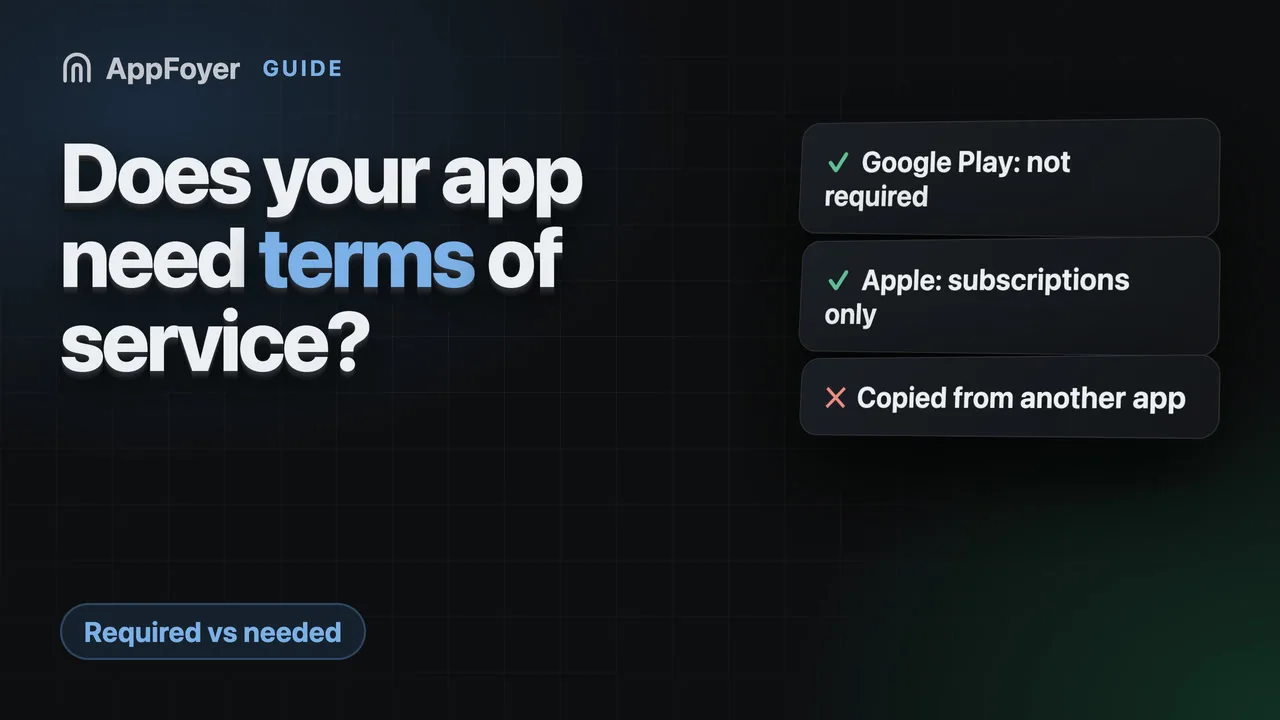
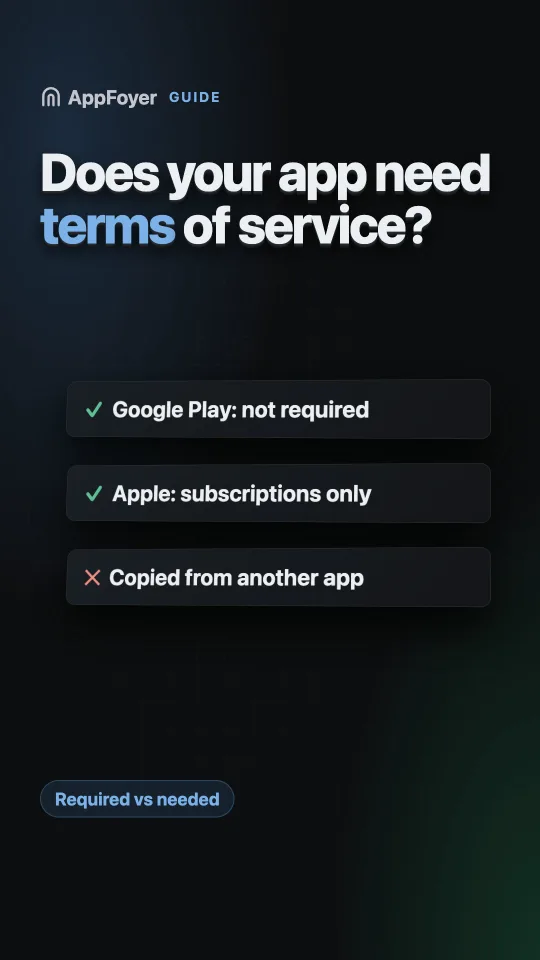
Google Play は利用規約を求めていません。求めているのはプライバシーポリシーだけです。Apple は Terms of Use のリンクを求めますが、自動更新サブスクリプションを販売するアプリに限られ、Apple の標準 EULA でそれを満たせます。それでもアカウント、支払い、責任の面で規約は重要なので、多くのアプリが公開しています。
数分で済ませる方法もあります
AppFoyer は、このガイドで扱っているページ(プライバシーポリシー、利用規約、サポート、アカウント削除、そして app-ads.txt)を、専用のサブドメインでホストします。自分のドメインもサーバーも要りません。アプリ 1 つまでは無料で、ストアが求めるものが有料プランの壁の向こうに置かれることは決してありません。
2026年9月19日 に確認。 ストアのポリシーは、予告なく変わることもあります。以下の内容はすべて公式ドキュメントにリンクしており、拠り所となるのはこのページではなくそちらです。両者が食い違う場合は、ストアが正しいものとしてください。 このガイドは英語からの翻訳です。ストアのドキュメントからの引用は原文の英語のまま掲載しています。
両方のストアが利用規約を求めている、と自信たっぷりに書いた記事がネット上にはたくさんあります。しかしストア自身のページを読むと、そうは書かれていません。そこで、この 1 つの問いに隠れている 3 つの異なる問いを分けて考える価値があります。
Google Play では必須か?
いいえ。Play の User Data ポリシーは、何をどこにリンクすべきかを具体的に定めています。“All apps must post a privacy policy link in the designated field within Play Console, and a privacy policy link or text within the app itself.”(訳:すべてのアプリは、Play Console 内の指定欄にプライバシーポリシーのリンクを掲載し、アプリ内にもプライバシーポリシーのリンクまたは本文を掲載する必要があります。)プライバシーポリシーが 2 回です。利用規約については何も書かれておらず、それを入力するコンソールの欄もありません。
Play Console の App content(アプリのコンテンツ)セクションで求められるのは、プライバシーポリシーのURL と、アプリにアカウントがある場合はデータ削除の URL です。規約はそこに含まれません。
Apple では必須か?
1 つのケースに限られますが、よくあるケースです。自動更新サブスクリプションを提供するアプリです。ガイドライン 3.1.2 は、プライバシーポリシーと Terms of Use (EULA) の両方へ機能するリンクを、アプリ内とメタデータの両方に置くことを求めています。
その EULA を自分で書く必要はありません。Apple が標準のものを公開しており、代わりにそれへリンクできます。それぞれをどこに置くかは Terms of Use (EULA) ガイドを参照してください。
サブスクリプションのないアプリについては、Apple も規約を求めていません。
では、なぜほぼすべてのアプリにあるのか?
「ストアで必須ではない」と「規約は要らない」は別のことだからです。規約は、プライバシーポリシーでは扱わない問いに答える文書です。
- 誰がアプリを使えるか、そして誰かが悪用したときにどうなるか。規約がなければ、アカウントを停止する根拠を示せません。
- あなたがユーザーに負うもの、負わないもの。 保証の否認と責任の制限はここに書かれ、それこそが規約が存在する理由です。
- ユーザーがあなたに負うもの — 支払い、許容される利用、アップロードするコンテンツ。
- どの法律が適用されるか、紛争をどこで扱うか。
- 規約がどう変わるか、ある条項が無効だった場合にどうなるか。
アプリにアカウントがある、お金を受け取る、ユーザーのコンテンツをホストする、何らかのモデレーションを行う — いずれかに当てはまるなら、これらはいずれ答えが必要になる問いです。紛争の前に書くほうが、後で書くより安く済みます。
アプリの規約に入れるべきもの
実用的なセクション構成を、たいてい読みやすい順に挙げます。
| セクション | 何を定めるか |
|---|---|
| アプリの利用 | 利用許諾、許容される利用、アカウント停止の理由 |
| アカウント | 誰が登録できるか、停止する権利、ユーザーが削除する権利 |
| 購入とサブスクリプション | 請求、更新、返金 — そして支払いを処理するのはあなたではなくストアであること |
| 知的財産 | アプリの所有者、ユーザーがアップロードしたものの所有者 |
| 免責と責任の制限 | 文書の中核 |
| 変更 | 規約の更新方法とユーザーへの通知方法 |
| 連絡先 | 実在する連絡先 |
ここにないものに注目してください。データの取り扱いです。それはプライバシーポリシーに属するもので、2 つの文書に重複して書くと、やがて両者が矛盾することになります。
避けるべきこと
- 他のアプリの規約を名前だけ変えてコピーする。 他人の事業を説明する文書であるうえに、著作権の問題にもなります。
- できないことを約束する。 すべてのデータを即座に削除する、稼働時間を保証する、といった規約は、何も書かないより悪い結果になります。
- 管轄をでたらめに指定する。 準拠法は実際の結果を伴う実際の選択です。
- 隠す。 前回のリデザインで削除したリンクからしかたどり着けない規約は、防御としてほとんど役に立ちません。
AI アシスタントで書く
アシスタントは喜んで規約を書いてくれますが、よくある失敗はプライバシーポリシーと同じです。「アプリの利用規約」を頼むと、これまで読んだあらゆる規約の平均を書きます。仲裁条項、行ったこともない州の裁判所、稼働時間についての約束などです。下のプロンプトは、内容を上の標準的なセクションに絞り、書く前にアプリが実際に何をしているか(サインイン、購入、ユーザーコンテンツ)を確認させ、わからないことは作り上げる代わりに [confirm: …] で示させます。アプリが iOS で支払いを受け付ける場合は、Apple の標準 EULA へのリンクを必ず含めます。
全体をそのままコピーしてください。冒頭の角括弧内の事実を置き換えるか、そのままにしてアシスタントに質問させてください。
You are helping me write the terms of service for my mobile app. They will be published as a web page on AppFoyer, next to the app's privacy policy, and linked from the app and its store listings. They should be short, standard and true for this app.

## About the app

- App name: [app name]
- Developer / company: [developer or company name]
- Support email: [support email]
- Platforms: [Android, iOS or both]
- Store listings: [store listing URLs, or "not listed yet"]
- Where these terms will be published: [your AppFoyer site URL]/terms
- What the app collects, as I declared it: [what the app collects — e.g. account info, analytics, ads, crash reports, location, purchases, or nothing]
- Account deletion page: [your AppFoyer site URL]/account-deletion (only if the app has user accounts)
- Country whose law applies: [country, if you have one]

## Step 1 — find the facts

If you can read this app's source code, read only its build, manifest and store-metadata files — for example `build.gradle(.kts)`, `gradle/libs.versions.toml`, `AndroidManifest.xml`, `Podfile.lock`, `Package.swift`, `Info.plist`, `PrivacyInfo.xcprivacy`, `pubspec.yaml`, `package.json`, `app.json`. Do not open `.env` files, keystores, credentials or any other secrets, and do not change any file.

From them, work out only what changes the terms:

- whether users sign in or create accounts (Firebase Auth, Sign in with Apple, Google Sign-In and the like);
- whether the app sells in-app purchases or subscriptions (StoreKit, Google Play Billing, RevenueCat and the like);
- whether users can post, upload or send content that others see (chat, comments, photos, profiles);
- whether the app shows ads or links to third-party services.

Show me that short list with the file each fact came from and ask me to confirm it. If you cannot read the code, ask me these four questions instead.

## Step 2 — ask only what you cannot know

Then ask me, in one short numbered list, and wait for my answers:

1. The minimum age to use the app.
2. Whether the app is free to use for personal purposes only, or also for business use.
3. If users can post content: what is not allowed, and whether I may remove it or close accounts.
4. Anything else you could not determine.

Never guess. Where I do not know an answer, write `[confirm: …]` in the text instead of inventing one.

## Step 3 — write the terms

Sections, in this order, leaving out any that do not apply: Acceptance of these terms · Use of the App · Accounts · Purchases and subscriptions · User content · Intellectual property · Third-party services · Disclaimer and limitation of liability · Termination · Changes to these terms · Governing law (as the placeholder below) · Contact.

- Standard, plain-language terms for a mobile app. Keep each section to a few sentences; this is not a contract negotiation.
- Purchases and subscriptions: payments are processed by the app store, prices are shown before purchase, subscriptions renew automatically until cancelled in the store account settings, refunds follow the store's policy.
- Disclaimer and limitation of liability: the app is provided "as is", and liability is limited "to the extent permitted by law".
- Do not describe how personal data is handled; that is the privacy policy's job.
- Do not promise what I cannot guarantee — uptime, instant deletion, error-free operation.
- Do not invent a company address, a court, arbitration or a jurisdiction — use `[confirm: …]`.
- Do not copy another app's terms.
- Start with `# Terms of Service`, then the line `_Last updated: [today's date]_`.
- Write these placeholders exactly as shown, never the values — they are filled in from my settings when the page is published: `{{app_name}}`, `{{developer_name}}`, `{{support_email}}`, `{{public_url}}`.
- In the Contact section, write the address as `[{{support_email}}](mailto:{{support_email}})`.
- Refer to the privacy policy as `[Privacy Policy]({{public_url}}/privacy)` instead of describing data handling here.
- If the app has user accounts, say in the Accounts section that users can request account deletion at `[{{public_url}}/account-deletion]({{public_url}}/account-deletion)`.
- Mandatory if the app is on iOS and has any in-app purchase or subscription — declared above, found in the build files or confirmed by me: in the Purchases and subscriptions section, include this sentence unchanged: For the iOS version, Apple's standard [Licensed Application End User License Agreement](https://www.apple.com/legal/internet-services/itunes/dev/stdeula/) applies to your use of the App. Never leave it out when the app takes payments.
- For governing law, write the line `{{governing_law}}` on its own and nothing else — it becomes the governing-law section when a country is set in my settings, and disappears when none is.
- End with this paragraph, unchanged:

  _This page was generated from a template provided by the hosting platform and completed by the app developer. It is not legal advice. The developer named above is solely responsible for its accuracy and for complying with the laws that apply to them._

## Format — this is pasted into a Markdown editor

- Reply with the finished terms only, as Markdown inside one ```markdown code block, with nothing before or after it.
- CommonMark only: headings, paragraphs, lists, bold, italics and links. No tables, no HTML, no images, no footnotes.
- Links only to `{{public_url}}` (for example the privacy policy), to Apple's EULA as above and to the support email. Any other link is shown as plain text on the published page, so leave it out. No link shorteners, no download links.
これは AppFoyer で公開するページ向けに書かれているため、{{app_name}} のようなプレースホルダーを求め、最後に当社の免責文を入れています。他の場所で公開する場合は、Step 3 のそれらの行を削除し、代わりに値を求めるようにしてください。プライバシーポリシーについてはAI アシスタントでプライバシーポリシーを書くを参照してください。
AppFoyer がここで行うこと
規約は、プライバシーポリシー、サポート、アカウント削除のページと並んで、当社が生成する 5 つのページの1 つです。テンプレートは上記のセクションを網羅し、アプリ名、開発者名、サポートの連絡先、ストアのリンクを埋め込みます。アプリが iOS でサブスクリプションを販売すると伝えれば、Apple の標準 EULA へのリンクを含むサブスクリプションのセクションも追加します。
ダッシュボードの規約エディタには Write it with your own AI(自分の AI で書く)パネルもあります。上のプロンプトに、あなたのアプリの詳細があらかじめ入力されたものです。好きなアシスタントで実行し、返答を貼り付け、プレビューを読んで公開します。
コンプライアンスチェックリストは、ページが公開されるまで、またサブスクリプションアプリの場合はEULA のリンクが実際に入るまで、そのページを指摘し続けます。
生成されるすべてのページと同じく、これはあなたが完成させ、責任を負うテンプレートであり、法的助言ではありません。アプリがお金、健康データ、子どもに関わる場合は、弁護士に読んでもらってください。
公式の情報源
- User Data policy — Google Play ヘルプ。上の引用はこのページからです。
- App Store Review Guidelines — Apple。セクション 3.1.2 がサブスクリプションの規則です。
- Licensed Application End User License Agreement — Apple の標準 EULA。